

Spray Foam Insulation Rental: Save Money on Your Next Large Insulation Project
If you’re planning a large insulation project, you have several options. You can hire a professional spray foam contractor, purchase your own spray foam equipment, or rent professional spray foam insulation equipment and complete the project yourself.
For contractors, builders, property owners, and experienced DIYers, renting can be an economical way to access professional spray foam equipment without the significant upfront investment of purchasing a complete system.
Master Pack’s Spray Foam Insulation Rental Program provides the equipment, training, and support needed to tackle medium and large spray foam insulation projects.
Why Rent Spray Foam Insulation Equipment?
Professional spray foam equipment can be expensive, particularly if you only plan to use it for one or two projects.
Master Pack’s rental program eliminates the need to purchase expensive dispensing equipment and offers a 30-day rental period, with extensions available when additional time is needed.
Master Pack also promotes its rental program as a way to potentially save compared with hiring a contractor, depending on the size and requirements of your project.
Benefits of Renting Include:
- Avoid the expense of purchasing spray foam equipment
- 30-day rental period
- Rental extensions available
- Professional spray foam dispensing equipment
- On-site training available
- Safety training and accessories
- Class I fire-retardant foam options
- Equipment suitable for medium and large projects
- Access to technical support
The Master Pack Model 776 Spray Foam System
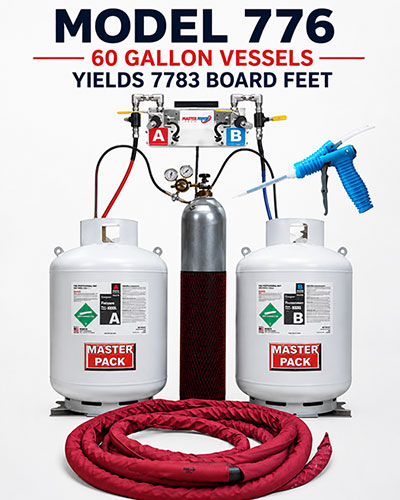
One of the primary systems available through Master Pack’s rental program is the Model 776 spray foam dispensing system.
The Model 776 is available with different pressure-vessel configurations, making it suitable for a variety of project sizes.
The 60-gallon configuration uses two 60-gallon pressure vessels and is rated at approximately 7,783 board feet of foam at 1-inch thickness. The system also includes an automatic calibrator pump designed to help maintain the proper 1:1 chemical ratio during dispensing.
The system uses lightweight hoses available in different lengths, allowing you to work across larger areas without constantly moving the equipment.
Looking for a Smaller System?
Master Pack also offers a Model 776 configuration using 17-gallon pressure vessels, with a listed yield of approximately 2,010 board feet.
This configuration can be an option for smaller applications while still providing the advantages of a refillable professional dispensing system.
What Size Project Is Right for a Rental System?
One of the most important questions to answer before renting spray foam equipment is how much foam your project requires.
Master Pack’s rental equipment is designed for medium and large applications, including commercial projects and large homes.
Before renting, calculate your project’s estimated board footage.
What Is a Board Foot?
A board foot is a measurement used to calculate the volume of spray foam insulation.
1 board foot = 1 square foot of coverage at 1 inch thick.
For example:
- 1,000 square feet × 1 inch = 1,000 board feet
- 1,000 square feet × 2 inches = 2,000 board feet
- 2,000 square feet × 2 inches = 4,000 board feet
Knowing your approximate board footage can help you determine which equipment and quantity of foam you’ll need.
Rent vs. Hire a Spray Foam Contractor
For a large insulation project, hiring a contractor is certainly an option. However, the labor costs associated with professional installation can be substantial.
Renting equipment allows qualified customers to take on the application themselves.
This can be an attractive option if you have the necessary labor, time, and experience to complete the project.
Renting May Make Sense If:
- You have a large insulation project
- You have the labor to complete the project
- You want more control over the project schedule
- You expect to use a substantial amount of spray foam
- You don’t want to purchase permanent equipment
- You’re a contractor adding spray foam to your services
For smaller projects, however, a disposable DIY Spray Foam Kit may be more appropriate.
Explore Master Pack’s DIY Spray Foam Kits →
Master Pack Provides Spray Foam Equipment Training
Renting professional spray foam equipment is different from purchasing a small DIY kit.
That’s why training is an important part of the rental program.
Master Pack offers two-day on-site training in the contiguous United States. Training covers equipment operation and spray foam application techniques.
Proper preparation, personal protective equipment, ventilation, equipment setup, and following the manufacturer’s product instructions are essential when applying spray polyurethane foam.
Class I Closed-Cell Spray Foam
Master Pack offers Class I, 1.75 lb. density closed-cell foam for its refillable systems.
Closed-cell spray foam can provide both insulation and air sealing, making it a popular choice for a variety of residential, commercial, and industrial applications.
Always verify that the specific foam product you select is appropriate for your application and meets your local building requirements.
A More Flexible Way to Tackle Large Projects
One of the biggest advantages of renting is flexibility.
Master Pack’s standard rental program is based on a 30-day rental period, and rental extensions can be accommodated when a project takes longer than expected.
That can be particularly helpful when you’re working on a large home, commercial building, warehouse, agricultural building, or other project where scheduling can affect the installation timeline.
Who Should Consider Renting Spray Foam Equipment?
Contractors
If you’re a general contractor or insulation contractor looking to add spray foam to your services, renting equipment can allow you to take on projects without immediately investing in a complete spray foam system.
Builders
Builders working on large homes or commercial projects can use rental equipment to complete spray foam applications without purchasing permanent equipment.
Property Owners
Owners of large buildings, warehouses, workshops, agricultural structures, and other properties may find rental equipment to be an economical alternative to hiring a contractor.
Experienced DIYers
If you’re comfortable taking on a substantial insulation project and have the appropriate labor and preparation, renting professional equipment may be an alternative to purchasing multiple disposable kits.
Don’t Buy Expensive Equipment for a One-Time Project
If you only need professional spray foam equipment for a single project, purchasing a complete system may not make financial sense.
Renting gives you access to professional equipment when you need it without making the equipment itself a permanent investment.
And because Master Pack offers training and support, you’re not simply receiving equipment and being left on your own.
Ready to Rent Spray Foam Equipment?
If you’re planning a large insulation project and want to explore an alternative to hiring a contractor, Master Pack’s Spray Foam Insulation Rental Program may be worth considering.
With professional dispensing equipment, flexible rental periods, training, safety accessories, and spray foam products available, Master Pack can help you get the equipment and materials you need for your project.
Call Master Pack at 866-799-3626
Important: Master Pack is a supplier of spray foam products and equipment and provides training. Master Pack is not a spray foam installation contractor.